From pilot to production.
Most enterprise AI dies between the demo and the deployment. We’re the team that gets it across — because we run our own AI products through the same gauntlet every day.

The demo always works.
That was never the hard part.
Everybody has seen the demo by now. It was impressive, it ran in about four seconds, and then somebody pointed it at the real customer table and discovered four competing definitions of “active,” a policy engine still living on a mainframe, and a compliance team who quite reasonably want to know how a decision got made before they will sign anything.
That is where the programme stops. Not because the model was wrong. Because six unglamorous problems sit between the model and the business, and on most programmes no single person owns any of them: data lineage, access to the system of record, evaluation, governance, change management, and whoever is going to pick up the phone at 3am when it does something strange.
Those six are the job. We take all of them.
What we do
Agentic systems that do real work
Agents wired into the systems where your work actually lives, with an evaluation harness, human checkpoints, and a rollback path. Things that close the ticket, reconcile the ledger, and draft the filing, rather than things that talk about doing so.
Explore agentic AI →A control plane your regulator will accept
An AI governance framework mapped to NIST AI RMF and ISO/IEC 42001, with a live model inventory, risk classification, evaluation gates, and audit evidence generated automatically rather than assembled the week before the audit.
Explore governance →The unglamorous work nobody else will do
Mainframe, data, and cloud migration, run by people who have actually read a copybook and know what a batch window costs. The model on top is only ever as good as the platform underneath it.
Explore modernisation →We don’t just advise. We ship.
Two products, built and run by us, in two markets that punish shortcuts: hospitality operations and the consulting room. They are how we keep ourselves honest. It is difficult to sell a client a method you have not been willing to bet your own uptime on.
AI-native property management
The PMS that runs the property, not just the record of it. Autonomous rate strategy, housekeeping orchestration, and guest messaging in one system.
Explore Stayligent →The platform that sits across the whole consultation
Diagnosis support from the spoken history and whatever reports the patient brought. Prescription options with the price and the citation attached. Then a follow-up on WhatsApp three weeks later, when everyone else has moved on.
Visit Auscura →88% of enterprise AI pilots never reach production.
That number is from Forrester and Anaconda’s 2026 research, and it is why we spend the first week of an engagement arguing about measurement rather than architecture. Four things we commit to before any work starts.
We’ll publish our own client outcomes on this page as engagements complete and clients approve the numbers. Until then it stays empty rather than filled with somebody else’s results.
Four phases. No 200-slide deck.
Frame · 2–3 weeks
We map your value chain, inventory candidate use cases, and score them on value against feasibility and risk. You leave with a ranked portfolio and an honest list of what to kill.
Prove · 6–8 weeks
One use case, built properly, in your environment, against your data. Evaluation harness from day one. It either hits the pre-agreed metric or we tell you why it can’t.
Scale · ongoing
Production hardening, platform patterns, governance controls, and the reference architecture the next ten use cases will reuse.
Transfer
Your engineers pair with ours from Phase 2. We are not building a dependency. Success is you not needing us.
Four things that are actually different
Our own money is on it
Stayligent and Auscura have real customers, real availability commitments, and real regulatory exposure. When we recommend an approach, we have already lived with the consequences of it.
Governance is architecture, not paperwork
The control plane gets designed at the same time as the system. Bolting governance onto an agent that already shipped costs roughly three times as much and works about half as well, which we know because we have been asked to do it.
We do the legacy work
COBOL, JCL, batch windows, EBCDIC, copybooks that describe a version from two rewrites ago. Most AI firms quietly subcontract this. We keep it in house, because it is where your data actually lives and the AI roadmap is usually blocked behind it.
Small teams, senior people
No pyramid, no bench being trained on your budget. The architect who scoped the work is on the build, and stays there.
Tell us what’s stuck.
Bring us the use case that stalled, the modernisation that’s been “next year” for three years, or the governance question your board asked that nobody could answer. First conversation is a working session, not a pitch.
Products we build, ship,
and operate.
A firm that has never carried a pager gives noticeably different advice from one that has. We build products for two reasons. They are good businesses, and they stop us from recommending things we have not had to live with. Every pattern, evaluation method, and governance control we bring into a client engagement earned its place by working on our own systems first, or by failing on them, which is usually the more instructive outcome.
Stayligent
An AI-native property management system for hotels, resorts, and serviced apartments. Rate strategy, housekeeping orchestration, and guest communication in a single operating system for the property.
Explore Stayligent →Auscura
An integrated platform for the consulting room: diagnosis support built from the spoken history and the patient’s own reports, prescription intelligence that shows cost and evidence side by side, and a follow-up loop that finally closes.
Visit Auscura →Your PMS should run the property.
Not just record it.
Most property management systems are databases with a booking screen attached. Stayligent is an operating system for the property — it watches demand, prices the room, sequences housekeeping, and answers the guest, and it tells you every time it does.
Built and operated by JPM AI Labs
Stayligent is one of two products we build and run ourselves — with paying customers, real availability commitments, and real operational exposure. The engineers who carry the Stayligent pager are the same ones who show up to client work. It is how we keep ourselves honest about what production AI actually takes.
One system, not five
Reservations, front desk, housekeeping, guest messaging, and revenue management in a single platform. No more midnight reconciliation across bolt-on tools.
Autonomous rate strategy
Dynamic pricing that watches demand, comp set, and local signals — and moves rates inside guardrails you set, with a one-click undo and plain-English reasoning.
Conversations, handled
Pre-arrival to post-stay messaging across WhatsApp, SMS, and email. Routine requests resolved end to end; anything sensitive escalates to a person with full context.
Six minutes per patient.
Auscura gives you four of them back.
An OPD doctor in a busy clinic sees fifty patients before lunch. Auscura sits across the whole visit: it listens and structures the history, works out the drug options with the evidence attached, and then keeps asking the patient how they’re doing three weeks later, when everyone else has moved on.
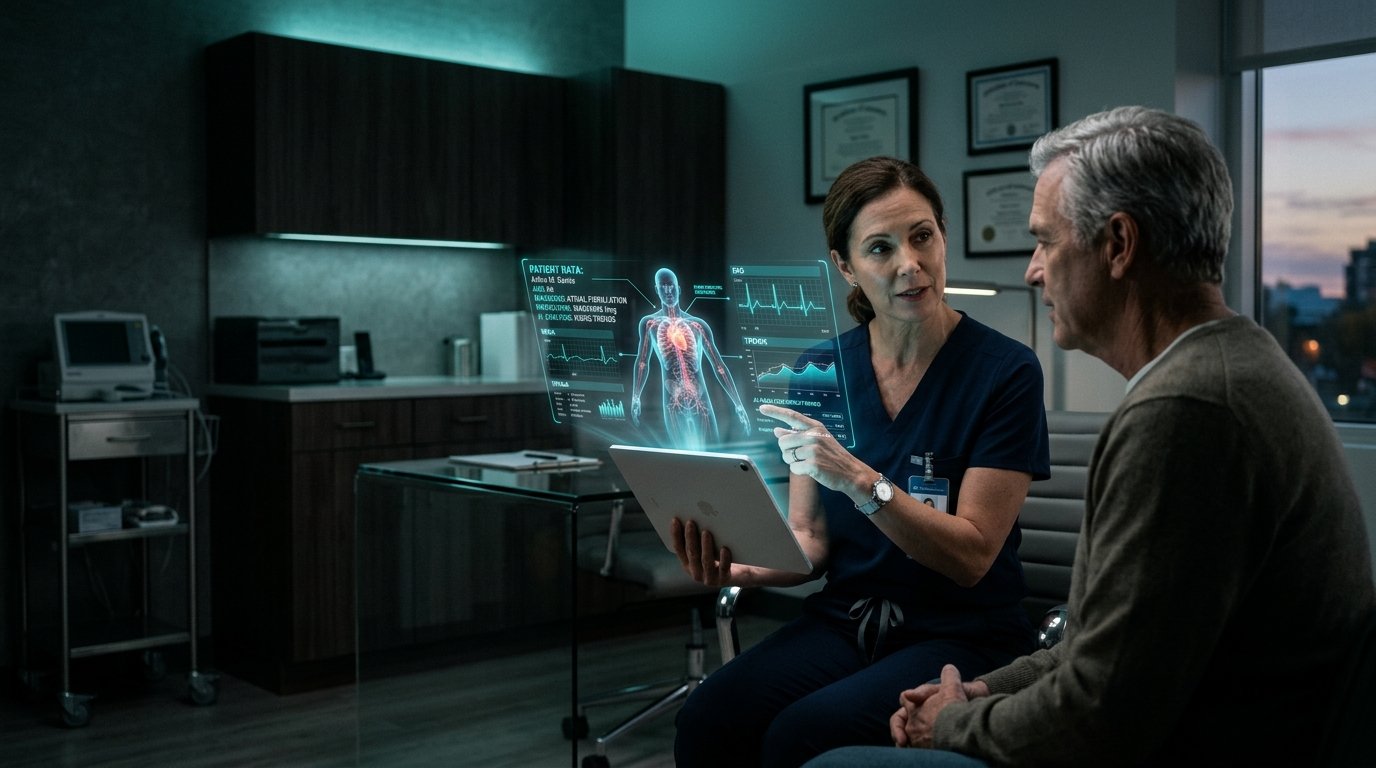
What actually happens in an OPD
A patient walks in with a plastic bag. Inside it: two lab reports, a discharge summary from a hospital eighteen months ago, and a strip of tablets with the foil cut so the name is half gone. She has six minutes. The doctor writes on a pad, in handwriting the pharmacist will interpret creatively, and by the time she reaches the counter the brand has been substituted for whatever the shop stocks.
She was prescribed a three-month course. She stops in week two because the monthly cost was ₹1,400 and nobody asked her what she could afford. The doctor never finds out. He has no mechanism to find out, and forty more patients waiting.
There are five thousand brands of the same handful of molecules on the Indian market. No clinician can hold the price spread in their head, and the person who most reliably tells them what to prescribe is the medical rep who came by on Tuesday. That is the market Auscura is built for.
Three modules, one visit
Diagnosis, prescription, follow-up. Most tools pick one and leave the seams to you.
Diagnosis support
Consent first. Then Auscura listens to the consultation, reads whatever the patient brought with them, and hands back a structured picture instead of a wall of transcript.
Prescription intelligence
Search by brand or by molecule. See monotherapy against combination options, filtered for what the patient can tolerate and what they can afford, with the journal or guideline behind every option.
Follow-up that actually happens
Structured check-ins over WhatsApp or the app, timed to the drug rather than to the calendar. The answers come back to the doctor, not into a void.
The history is already being spoken. Nobody is capturing it.
How it works
- Consent is the gate. Nothing records until the patient has said yes, in their own language, and the consent is timestamped and stored against the encounter. Withdrawal deletes the audio. We built this first because a platform that treats consent as a checkbox does not deserve to be in the room.
- Voice capture of the dialogue. The consultation happens in Hindi, or Marathi, or code-switched English, the way it always does. Auscura handles the mix and produces a structured history: onset, duration, severity, aggravating factors, negatives that were actually asked.
- Reports go in as they arrive. A photo of a lab printout taken at an angle in bad light. A PDF discharge summary. Auscura pulls the values, plots the trend if there’s a prior, and flags what’s out of range against the patient’s own baseline rather than a generic one.
- What comes back. A one-screen summary, a differential the doctor can accept or throw away, red flags called out separately, and — the part clinicians tell us they use most — a short list of what is missing. Which single test would most change the picture.
- Every line is sourced. Tap any statement in the summary and it opens the moment in the transcript or the line in the report it came from. Nothing is asserted without a trail back to where it came from.
Auscura proposes. The doctor decides. Always.
The differential is a prompt for thought, not an answer. It is presented as a ranked list with the reasoning shown, it can be dismissed in one tap, and the dismissal is logged. No diagnosis is recorded, no prescription is generated, and nothing reaches the patient until a registered clinician has reviewed and signed it. That constraint is enforced in the product, not in a policy document nobody reads.
⚠ Regulatory: diagnosis support and prescription recommendation sit in a materially higher-risk lane than documentation alone. Get your regulatory pathway confirmed by counsel in each market before publishing any clinical claim. See the content deck for the full note.
Five thousand brands. One molecule. Nobody can hold that in their head.
This is the part of Auscura we spent longest on, because it is the part where the money and the adherence and the outcome all get decided in about eleven seconds.
Brand → molecule → options
Type the brand. Auscura resolves it to the exact formulation and its underlying molecule or molecules, then opens up what you actually have a choice about:
- Single-pill therapy. Monotherapy, or a fixed-dose combination where one exists. Fewer tablets, better adherence, usually the right answer when it’s available.
- Multi-drug therapy. Where combination is clinically indicated, laid out with the dosing schedule, the interaction check already run, and the sequencing.
Molecule → every brand carrying it
Search the molecule and get every brand that contains it, with strength, composition, and the price band. The ₹1,400 option and the ₹190 option sit next to each other on the same screen.
This one screen is the most-used in the product. It is also, quietly, the most consequential: it is where the substitution decision moves from the pharmacy counter back to the consulting room.
Patient-friendly
Ranks options by pill burden, dosing frequency, whether it can be taken with food, tolerability profile, and formulation (a syrup for the elderly patient who cannot swallow tablets). A once-daily single pill that gets taken beats a twice-daily pair that does not.
Pocket-friendly
Ranks by monthly cost of the full course, not per-strip price, with generic equivalents surfaced alongside. Cost is a clinical variable in most of the world. A prescription the patient abandons in week two has an efficacy of zero regardless of what the trial said.
Every option carries its source
Pick any drug and Auscura shows the full composition and, beside it, what recommends it: the guideline body and version, the journal, the trial. Not “evidence-based” as a marketing adjective. The actual citation, with the year, linked, so a doctor can open it in the ten seconds before the next patient or defend the choice a year later in front of somebody asking why.
- Guideline body + version
- Journal citation + year
- Level of evidence
- Indication match
- Contraindication check
- Interaction check against current meds
- Last reviewed date
Where the evidence is thin or contested, Auscura says so rather than picking a side and hiding the disagreement. [Confirm licensing for each guideline and drug database you surface — this is a commercial dependency, not a technical one.]
The prescription leaves the room and the loop never closes.
Ask a doctor what happened to the patient they started on a new antihypertensive six weeks ago and you will usually get an honest shrug. Not through indifference. There is simply no channel. The patient comes back or they don’t, and if they don’t, that silence gets read as success.
How Auscura closes it
- On WhatsApp, because that is where the patient already is. No download, no login, no app the patient opens once and deletes. A message arrives in the thread they use for everything else. For clinics that want it, the same flow runs in the Auscura patient app.
- Timed to the drug, not to the calendar. A check-in at day three for the antibiotic, day fourteen for the SSRI when the side effects usually land and the benefit hasn’t arrived yet, day thirty for the statin. The schedule comes from the drug’s known onset and adverse-event profile.
- Questions a person can answer in a moving auto-rickshaw. Are you still taking it. Is the pain better, worse, the same. Any of these four things happening. Short, structured, tap-to-answer, in the patient’s language.
- Adherence is measured, not assumed. If the answers stop, that is a signal, and it is the single strongest early predictor that the course has been abandoned.
- Red flags escalate immediately. A reported symptom that matches a serious adverse reaction pattern goes to the clinician on the same day, marked, ahead of the routine queue.
- It comes back as a worklist. Not a dashboard the doctor is supposed to remember to open. A short ranked list of the patients who need something, in the software they are already in.
Real-world response data nobody else has
Every completed follow-up is a data point on how a specific molecule behaved in a specific kind of patient, in this population, at this dose. Trials tell you what happened to a selected cohort in a controlled setting, usually somewhere else.
After a year, a practice running Auscura can answer a question its own registry could never answer before: for patients like this one, in this clinic, which of these two options actually worked. That is the asset. Everything else is the mechanism for building it.
Safety, privacy, and the things we won’t do
- A licensed clinician signs everything. No diagnosis, prescription, referral, or patient message leaves Auscura unreviewed. Enforced in code.
- Auscura does not treat and does not triage autonomously. There is no mode, no setting, and no enterprise tier in which it does. We would rather lose the deal than ship that.
- Consent is revocable and the revocation is real. Withdrawal deletes the audio and stops future contact, verifiably, within [N] hours.
- Bias monitoring across cohorts. Differential quality and prescription recommendations measured by age, sex, language, and socioeconomic proxy, and the results are shown to customers rather than filed internally.
- Your patient data does not train foundation models without a separate agreement you can revoke. In healthcare procurement this is the clause that gets read twice. Make it true before you print it.
- Continuous clinical review. Output quality benchmarked against clinician-adjudicated gold standards, overseen by [clinical advisory board]. Degradation triggers rollback, not a retrospective.
Compliance posture
- [DPDP Act 2023 posture]
- [HIPAA + BAA, if US]
- [ABDM / NDHM alignment]
- [SOC 2 Type II]
- [Data residency]
- Encryption in transit & at rest
- Audio retention [N] days
- Full access audit trail
Outcomes
| Consultation time recovered per patient | [X] min |
| Prescriptions where a lower-cost equivalent was chosen | [X]% |
| Follow-up response rate at day 14 | [X]% |
| Courses abandoned early, detected | [X]% |
| Adverse events surfaced before the next visit | [X] |
⚠ Illustrative. Replace with measured pilot data. The second row is the number that sells this to a hospital administrator; the fourth is the one that sells it to a clinician.
Who it’s for
- High-volume OPD and outpatient clinics where the constraint is minutes per patient, not access to information.
- Single-specialty chains — cardiology, diabetology, psychiatry — where the same molecules recur and the follow-up window is well defined.
- Multi-location hospital groups wanting prescribing consistency across sites without turning it into a policing exercise.
- Individual practitioners who want the molecule search and the follow-up loop and none of the enterprise apparatus.
Start with one clinic and one specialty.
Give us [N] weeks with [N] doctors. We’ll baseline consultation time, prescription cost, and follow-up response before we start, and we will show you the numbers afterwards whether they flatter us or not.
Disclaimer. Auscura is a clinical decision support and workflow tool intended for use by qualified, registered healthcare professionals. It does not provide medical advice, diagnosis, or treatment to patients, and it is not a substitute for clinical judgement. All diagnostic and prescribing content generated by Auscura requires review and sign-off by a registered clinician before it is acted upon. Drug, dosing, and interaction information is provided for reference and must be verified against current approved product information. [Regulatory status and jurisdictional statements to be confirmed with counsel in each market.]
Nine practices.
One thesis.

Enterprise AI fails in predictable places: an unclear portfolio, an unusable data estate, a system of record nobody can integrate with, and a governance model that arrives after the lawyers do. Our practices exist to close those gaps in the order they actually block you — which is usually not the order you expected.
Newsroom
Product releases, engineering write-ups, and what we’re learning shipping AI into places where mistakes are expensive.
⚠ Illustrative. These are launch-window templates written to show voice, category mix, and headline structure — not published facts. Recommended cadence: two substantial pieces a month, weighted 40% engineering notes, 25% product, 20% point of view, 15% company.
Media enquiries
[PR contact] · [email] · [phone]
Download: logo pack · brand guidelines · executive bios · product screenshots.
Boilerplate
JPM AI Labs is an AI engineering company that builds and operates its own AI products and helps enterprises put AI into production. Its portfolio includes Stayligent, an AI-native property management system for hospitality, and Auscura, an integrated clinical platform for diagnosis support, prescription intelligence, and patient follow-up. Its services practice spans AI strategy, agentic AI engineering, AI governance and automation, digital transformation and mainframe modernisation, data and cloud migration, analytics, business intelligence, and programme management consulting. Headquartered in [city]; clients across [regions].
The work, in their words.
Every quote below is published with the client’s written permission, and every number is one they verified. Where a client can’t be named, we say so rather than inventing a description that makes them identifiable anyway.
⚠ Everything on this page is a structural template. Replace entirely with real, permissioned material. A single invented testimonial, discovered, ends the credibility of every other page on this site.
[Client] · [Sector]
Challenge
[N]M lines of COBOL in policy administration. [N]-day change cycles. Two remaining subject-matter experts.
Approach
Full dependency mapping, business rule extraction into a reviewed specification, strangler migration of [N] capabilities over [N] months, continuous parallel-run reconciliation.
Results
[Outcome 1] · [Outcome 2] · [Outcome 3]
“[Quote — ideally naming a specific fear that didn’t materialise: the parallel run, the cutover weekend, or the regulator’s reaction.]”[Name][Title], [Company]
[Client] · [Sector]
Challenge
[N] work items handled manually per month, [N]-day backlog, [N]% requiring rework.
Approach
Workflow decomposition, a [N]-agent orchestration wired to [system], evaluation harness with [N] scored scenarios, human review above a defined confidence threshold.
Results
[Outcome 1] · [Outcome 2] · [Outcome 3]
“[Quote]”[Name][Title], [Company]
Quote wall
“[The specific thing they were sceptical about, and what changed their mind.]”[Name][Title], [Company] · AI Governance
“[The moment the parallel run caught something the old process missed.]”[Name][Title], [Company] · Data Migration
“[What their team can now do without calling us.]”[Name][Title], [Company] · Cloud Migration
How we collect these
Method matters more than volume. Five specific, verifiable stories outperform thirty generic ones.
- Ask at the peak, not at the end. The best quote is available the week the outcome lands, not three months later during offboarding.
- Interview, don’t email a form. A 20-minute recorded call produces a usable quote; a blank text box produces “great partner, highly recommend.”
- Ask for the fear. “What were you most worried about, and what actually happened?” — the only kind of testimonial a sceptical buyer believes.
- Get written approval for the quote, the name, the title, the logo, and every number, from someone empowered to give it.
- Never fabricate or composite. Not once, not as a placeholder that might survive to launch.
We build what
we consult on.
The company started from a fairly specific irritation: the gap between what enterprise AI was promised to do and what it turns out to do once it is load-bearing, and the fact that most of the people advising confidently on the first had never once been accountable for the second.
So we set the company up so that we could not get away with it either. We build and run our own products, Stayligent in hospitality and Auscura in the consulting room, with paying customers, availability commitments, and genuine regulatory exposure. The engineers who carry that pager are the same ones who show up to client work.
It means our advice has consequences for us, which changes what we are willing to say. We turn down work fairly regularly. Usually because the data is not ready and the client would rather hear that in month one than month nine.

Principles
Say what won’t work
The most valuable thing we can tell you is often that your use case isn’t ready. It costs us revenue and it’s why clients come back.
Ship, then say
We don’t publish a capability until we’ve delivered it.
Governance is engineering
Anything that only exists in a policy document will be bypassed by the first team under a deadline.
Small and senior
No pyramid. The architect who scoped your engagement is on the build.
Leave capability behind
Our engagements are designed to end. Your team pairs with ours from the first sprint.
Measure or don’t claim
Every engagement publishes its success metric before kickoff. If it can’t be measured, we say so.
⚠ Still to build: leadership bios and photos · advisory board (the clinical advisors for Auscura are a significant trust signal in healthcare procurement) · locations · certifications and partnerships, real ones only, with status and date.
Small teams. Hard problems.
Real production.
We’re a small, senior team, and we intend to stay that way. If you want to write a strategy deck about AI, we’re the wrong company. If you want to be accountable for an agent that runs unsupervised against a system of record at 3am — and to build the evaluation harness, the rollback, and the governance that makes that reasonable — we should talk.
- You’ll work on both product and client engagements.
- You’ll be the senior person in the room and expected to act like it.
- You’ll ship to production, not to a pilot environment.
- You’ll say no to work that shouldn’t be done, with our support.
Start with the thing
that’s stuck.
The first conversation is a working session with an engineer, not a discovery call with a salesperson. Bring the stalled use case, the modernisation that keeps slipping, or the governance question your board asked. You’ll leave with a point of view either way.
Book a working session
Direct
- General — contact@jpmailabs.com
- Stayligent — contact@stayligent.com
Offices
- US
1712 Pioneer Ave Ste. 500
Cheyenne, Wyoming 82001 - India
Plot No. 4706/5851(14), Gajapati Nagar, Bhubaneswar, Odisha, India – 751013